Showing posts with label environment. Show all posts

Thursday, March 01, 2007

the answer is?

The UN is asking that the United States becomes a leader in promoting cleaner energies and tackling the problem of global warming. The UN is encouraged by the response to An Inconvenient Truth in that there is now growing awareness of the problem of global warming. http://www.msnbc.msn.com/id/17401890/

Our local governor is supporting the exploration of biofuels as an alternative fuel source. Many people seem to think that alternative energies are the answer to all of our problems. Are alternative energies a solution?

Energy sources can be divided into renewable and nonrenewable.


Nonrenewable Renewable
Oil sands, heavy oil Wood/other biomass
Natural gas Hydro-electric power2
Coal Solar energy
Shale oil Wind energy
Gas hydrates Wave energy
Nuclear fission Tidal power
Geothermal1 Fusion

Ocean thermal energy conversion

1. Renewable for space heating 2. Not renewable with reservoirs

There are many options for alternative energy, however most of them are not as cheap as oil. There are pluses and minuses for each possible energy source. Some do not store well, some cost more to gather and store than it would to use oil. Some, such a biofuels may cause other problems such as the increased cost of food.

CORN: FUEL OR FOOD ???
By Mike Meyers Minneapolis-St. Paul Star Tribune
February 8, 2007
http://www.startribune.com/535/story/977495.html

"The number of hungry people worldwide could grow by more than 50% by 2020, as corn, sugar and other food staples are increasingly devoted to making fuel here and abroad, according to the projections by C. Ford Runge and Benjamin Senauer.

The same trend would bring much higher food prices to the United States and the rest of the developed world, the economists predict. The sharp increase in world hunger isn't inevitable, however. The economists say increased conservation could do more to wean the United States from foreign oil than all the corn-based ethanol plants now online."


Scientists urge sweeping measures to save world
"The scientists called for dramatic actions ranging from carbon taxes and a ban on conventional coal-fired power plants to an end to all beachfront construction worldwide. The researchers were funded by the non-profit UN Foundation and the research society Sigma Xi.

To meet the scientists' goal, global carbon dioxide emissions must level off by 2015 and then drop by two-thirds by 2100."

So, what is the answer? Perhaps combining technologies will help us. Perhaps using solar, wind, wave, and biomass in combination will help. I do not know. What I do believe, however, is that we need to change how we think about the energy we use. We need to realize that it will not "always be cheap and available." We need to think about how we can make personal changes in our lives to reduce the amount of energy we use. Does this mean trading in a gas guzzler for a more efficient vehicle? Does this mean that we should combine trips and use less gasoline? Should we unplug unused appliances? Should we replace our lightbulbs? The answer is ....

It is up to us. We should find ways to use less energy. Whatever that method is.

I am trying to look around my house and life and think about ways that I can personally reduce our gasoline and electric use - whether it is offset with wind or by buying carbon emissions, using less is better in the long run. I may not be able to trade my vehicle in for a smaller one, but I can choose to walk, bike, or combine trips. I can unplug the toaster when it is no longer in use and shut doors to bedrooms that are not used (why heat an unused room? ). Small actions can make a big change in our energy usage. Of course, any action can also reduce our carbon emissions....

It is up to us. What changes can you make to reduce your reliance on oil, natural gas, and electricity?

Tuesday, February 27, 2007

Conference on global warming


Last night I attended a conference on global warming. Actually, I had also been invited to have an informational table at the conference. So, I set up a table with my posters, some handouts (a version of the brochures), some flyers, and a sign-up sheet for local people to be notified about classes and get involved in our local community. People signed up!

Wow. It was excited to hear the reaction from people. Most people agreed that this was something that could be done. Reducing our food miles and thus cutting our food emissions is something that most of us can do - by planting our own food, or choosing to shop at the farmer's market or join a CSA (Community Supported Agriculture). I told people how I have eating within a 100-mile radius, preserved food throughout the summer and am sill eating locally. So many didn't know that it was possible to do this in Minnesota (in the winter). People were enthusiastic about this.

Some of the visitors to my table took materials to share with local groups. I was also invited to present at another conference in April, to get the Victory Gardens involved with the Land Stewardship Project, and to speak with some other groups. Look - one idea can have an impact. One action can make changes. We can all do something to make a healthy change for our environment.

One of the speakers at the conference was a local member of congress. He told us that we are making a difference. When we write to our legislators it does make a difference - they become aware that citizens are demanding change. He told us that global warming is a hot topic in Washington and that as we become active in cutting our emissions and demanding changes be made, that our voices are heard. We need to keep demanding legislation!

It is becoming clear that we can make a difference. We need to use our voices and write letters to the editor, write to legislators, make changes in our own lives. Some of the changes may be uncomfortable, but if we can think about our children and grandchildren and the benefits for them, then the changes can be less painful. I would personally prefer difficult changes now than a world that is difficult to live in in the future.

The problem with the topic of global warming is it is a topic that is "over there." We hear about it and think that it is something that the government has to do something about, or that is something bigger than us. It is big, however we are the individuals who can make a change that will make a difference. Every little change that we make adds up. The climate changes will affect us. Check to see how your local environment could be affected. Let's make a difference.

Sunday, February 18, 2007

A Sense of Entitlement

  • We would need four earths if everyone lived the western lifestyle.
  • A child born in North America or England will consume, waste and pollute more in a lifetime than as many as 50 children in a developing country.
  • The industrialized world uses close to 70% of all oil consumed in transport even though they make up only 20% of worlds' population.

My generation (early-mid 30s) is the first to be advertised to from the moment of our birth. We are the first to experience massive credit card debt. We were offered credit cards at the first moment we stepped onto a college campus. We are sold on consumption. We are requested to do our patriotic duty by shopping. This idea that we are meant (and entitled) to consume is dangerous to our moral fiber - we place more importance on our entitlement to consume than the consequences of these actions. Materialism, consumerism, and advertising have joined together to create very high expectations for the good life and a belief that we are all entitled to these expectations.

How many people do we know that have a large SUV and/or truck and refuse to trade down because they feel entitled to this vehicle. The problem is that we don't see the direct ramifications of driving this vehicle. It guzzles a lot of gas? "So what - I can afford it, " is the response. The consequences; carbon emissions and oil depletion - are not even a consideration. If it is something that we can afford, then it is something that we are entitled to.

A while ago, I posted something about the high costs of cashmere. The demand for cheap cashmere sweaters at big box stores has had huge impacts on the environment - the goats which are used to create cashmere are now creating desertification. When we demand so much stuff at a cheap price there are multiple larger costs. So many in our society either don't realize or care about the actions of purchasing a sweater - as the ramifications don't affect us directly. We can afford the sweater and that is what matters to us. The all-pervasive sense of entitlement has entered our western psyche - and is simply reiterated with every commercial and every trip to the store. We are entitled to anything and everything that is affordable. Those items that are not affordable now will be made affordable soon. We can all purchase all that we want.

We are taught to believe that we have a right to anything and everything that we want - if only we apply ourselves to it (and sometimes applying ourselves is not even necessary). It is a priority. In a consumer society, people have very high expectations for personal gratification. People feel that they are entitled to have all their expectations met. Life should be easy. The good life should be available to all - and easily attainable. People should get out of their way - it is a right. This narcissist behavior is frightening. We have all seen video of people pushing and jumping over each other for certain toys. You would think that these people were starving and pushing for the last grains of rice.

When oil depletes and becomes expensive, what is going to happen to those people who feel entitled to the "good life"? What will happen to those people who feel entitled to drive a gas guzzler? To those who feel entitled to eat strawberries in January? What is going to happen to the fabric of our society? Anger. Anger at the loss of ability to get anything that we want at any time we want it.

We need to change our sense of entitlement to one of appreciation. We need to learn to appreciate what we have rather than increasing desire. We need to understand the ramifications of consuming. We need to understand that our world cannot continue to sustain this mad rush of overabundance and instead enjoy what we have. We need to change the definition of the "good life." We need to make changes in our own lives (which can help change supply and demand). This takes a personal change - we cannot change the mindset of others. As we change ourselves we can show others that the good life may appear different than advertisements lead us to believe.

Thursday, February 08, 2007

The weather outside is frightful...

The past two weeks have brought frightfully cold weather to Minnesota. The past 14 days have been colder than normal. This morning was well below 0 degrees.

Last week brought about the UN climate change findings. With the cold weather here and amounts of snow elsewhere can be confusing. Global warming? where is it? With this weather it can't be happening! .... Some people have even commented that they would welcome a little global warming.

Well, there is a difference. What we are experiencing now is weather related. Weather is what happens on a day-to-day basis. While climate is long term. We should not confuse weather with climate!

What Weather Means

"Weather is basically the way the atmosphere is behaving, mainly with respect to its effects upon life and human activities. The difference between weather and climate is that weather consists of the short-term (minutes to months) changes in the atmosphere. Most people think of weather in terms of temperature, humidity, precipitation, cloudiness, brightness, visibility, wind, and atmospheric pressure, as in high and low pressure.

In most places, weather can change from minute-to-minute, hour-to-hour, day-to-day, and season-to-season. Climate, however, is the average of weather over time and space. An easy way to remember the difference is that climate is what you expect, like a very hot summer, and weather is what you get, like a hot day with pop-up thunderstorms. "

I found this image on arborday.org. It shows the changing climate between 1990-2006. I was surprised to learn that my zone has changed from zone 4 to zone 5! Click to see an animation which shows the drastic changes in climate.


How has your climate changed? This is happening. This is currently happening - not sometime in the future. It is happening now. How much will you do to cut your personal emissions?


In a few weeks I will be attending a local global warming conference and will have a Revive the Victory Garden table to share information about how people can change the impact of their food choices. On another note. I also created the posters for the conference. :)

Sunday, January 28, 2007

Victory Garden update


After the tremendous response to the idea for a victory garden to fight global warming, I created a poster, flyer, and tri-fold brochure. I am currently working on a website as well.
http://www.urbansustainableliving.net/VictoryGarden/

The poster is an 11x17 full color poster. The flyer is 8.5x11 black and white (can be photocopied). The brochure is a full-color trifold. These are all available on the website mentioned above.

This was fun to create. Yes, I enjoy using my graphic design powers for good. (I tease my students about having superpowers in design - and the need to choose to use the powers of persuasion for good rather than evil). Please feel free to use these.

Planting a Victory Garden can be such a simple step towards sustainability and easing our dependence upon pollution creating systems.

***** Edit
After contemplation, I changed the tag line to read "for victory over global warming." I had not realized how pervasive the term "fight the war on..." had become. It had become ingrained into my subconscious. I think it shows how hearing a phrase repeatedly seems to become part of the "norm" of our vocabulary.

I think "Victory over.." sounds more hopeful, yet is active enough to engage people who would otherwise not be interested.... And it still could be construed as a fight over something :)

Tuesday, January 23, 2007

Revive the Victory Garden


I am obsessed with food. Of all of things that we can purchase, food is the one thing that nourishes us. Yes, items can nourish our soul, but food is what nourishes our bodies - -so that we can live. I think this is why so many of my posts are about food. We cannot go without.

60 years ago we were at war. We were fighting an enemy at faraway lands. Our government encouraged us to plant gardens at home. People came together to fight this enemy by planting gardens in their backyards. These gardens could help us fight the enemy from home and gave our citizens a sense of national purpose. Magazines told people how to plant and tend to a garden. Co-ops were developed. This community effort brought together families and neighbors to provide their own food so that more was available for the war effort.

Today we are again at war. This enemy does not have a face. It is not an enemy that we can see. However, this enemy can threaten the nature of our lives and planet. This enemy is global warming. Let's fight is by planting a garden. A victory garden over global warming.

Why would planting a garden have an impact on global warming? Our current food system is created so that the salad that you are eating today (in January) has traveled over 1500 miles to get to your table. The lettuce and tomatoes have been sprayed with petroleum based pesticides, heavily packaged, and transported in air polluting airplanes and trucks. This salad has contributed to global warming.

Start making plans for the future. Dig up your lawn and plant a garden. If you don't have a lawn, put plants in pots on your patio or balcony. Use your rooftop. Or, if needed, visit your farmer's market. Eat with the seasons. Talk to a neighbor. Let's become a community fighting this enemy. Let's no longer make the 1500 mile salad a standard. Let's fight global warming with a victory garden.

btw, need more incentive? one 2 cent seed will provide many more veggies than you can purchase for that at the store. planting a garden will save money!

Wednesday, January 10, 2007

Ugly Reality

I just read an email which forwarded Sharon's post from her blog: http://casaubonsbook.blogspot.com/ called "Time to Face Ugly Reality." I recommend reading it!

Her post was very sobering. It directed me to a review of George Monbiot's new book called "Heat" which picks up where Al Gore left off on global warming. Heat offers real solutions without sugar-coating the large personal sacrifices they will require.

Gore and Monbiot both believe that the window of opportunity to make changes is very small -- less than 30 years. Gore made some small and easy recommendations at the end of his movie -- turning down the thermostat, driving less, changing light bulbs. Is it enough? Monibot doesn't think so.

Monbiot reluctantly concludes, "(T)here is simply no way of tackling this issue other than reducing the number, length and speed of the journeys we make." Knowing the audience for whom the book is intended, he acerbically adds, this will mean the end of "shopping trips to New York, political meetings in Porto Alegre, long distance vacations."

Monbiot sums up his findings, "I have sought to demonstrate that the necessary reduction in carbon emissions is -- if difficult -- technically and economically possible. I have not demonstrated that it is politically possible."

Is it politically possible? The last paragraph of Heat is not hopeful. "(T)he campaign against climate change is an odd one. Unlike almost all the public protests which have preceded it, it is a campaign not for abundance but for austerity. It is a campaign not for more freedom but for less. Strangest of all, it is a campaign not just against other people, but also against ourselves."

He shows us that most of the rhetoric we hear about greenhouse gas reduction is way off the mark. Two degrees Celsius above pre-industrial levels is the temperature level beyond which major ecosystems begin to collapse, and in order to prevent this from happening, rich nations must cut their greenhouse gasses by 90 percent or more by the year 2030.

I think that Monibot has made some very sobering but important conclusions. Gore did a great job of getting us to recognize the frightening facts of global warming and has given us very easy first steps. However, these are not solutions - they are very small steps to take. What they do well is introduce the topic of global warming in an accessible fashion. Everyone can change a lightbulb. It provides baby steps to help change the American mindset. What Monibot suggests is much more difficult -- we have to be willing to give up a lot. We have to be willing to travel less, consolidate trips, car pool, consume fewer products, eat locally, and eat less meat. We need to make drastic changes in how we choose to live.

According to a new report published by the United Nations Food and Agriculture Organization, the livestock sector generates more greenhouse gas emissions as measured in CO2 equivalent – 18 percent – than transport. It is also a major source of land and water degradation."

That release is at http://www.fao.org/newsroom/en/news/2006/1000448/index.html

What you eat -- meat vs. veggies -- could have more impact on global warming (at least in the short term) than how much you drive.

It made me realize what other changes I need to make. I am not doing enough. As a teacher, I realize how important education is. I want to educate others and provide methods for people to share and learn from one another. This last week I started a new email group (Sustainable Urban Living: UrbanSustainable@yahoogroups.com), as I realize how many of us want to learn to live sustain ably in our urban environment. I have contacted the campus about starting an educational movie series "Movies that Matter" in the hope to educate the community and follow with conversation. There are so many other things that could be done. I need to think about it.

Today I cut off my hair. It was weighing me down - literally and figuratively. I have/had very thick long curly hair. It is nearly impossible to wash. Simply getting fingers through the mass was difficult. It also took such huge amounts of conditioner and energy (warm water) to care for. I cut off over a foot. I also decided to no longer color my hair. Yes, I may have some premature gray hairs, but I will accept those rather than add the cost to the environment. I also told my stylist to watch An Inconvenient Truth. She had never heard of it.

As Sharon stated in her posting "Time to Face Ugly Reality," we truly need to make an 80% reduction in what we do and consume so that our children have a habitable planet. We do not own the earth we borrow the land from our children.

Saturday, January 06, 2007

Light bulbs and more


I created this pretty cool logo before the holidays (at least I think it is cool). The logo was ironed onto canvas bags.

Within the canvas bags I had items for reduce, reuse, and recycle.


I included a compact florescent light bulb with the tag attached.

The tag says "If every U.S. family replaced one regular light bulb with a CFL, it would eliminate 90 billion pounds of greenhouse gases, the same as taking 7.5 million cars off the road."


The canvas bag had this attached:
"Each year, an estimated 500 billion to 1 trillion plastic bags are consumed worldwide. That comes out to over one million per minute. Billions end up as litter each year."


I had some local food:
"The average fresh food item on our dinner table travels 1,500 miles. Buying locally produced food eliminates the need for all that fuel-guzzling transportation."


And finally one that talked about recycling:
"Recycle cans, bottles, plastic bags, and newspapers. When you recycle, you send less trash to the landfill and you help save natural resources, like trees, oil, and elements such as aluminum."


I didn't get much response from the gifts - other than "oh, I didn't know that." Maybe it planted a seed.

What I am gong to do is start printing out the light bulb statement and purchase some light bulbs and start giving them to random people (with this message attached). A light bulb is such an easy start - and a cheap way to give a message to others. Does anyone want to join me in doing this? If you do, please let me know - I can make some of these larger or in a PDF form so that you can print out and pass on the messages.

Just a small idea that could have a difference. :)


***
Edited addition as of 2:00 PM ***

for those of you who want to join in, I have created a PDF that you can print out and cut to attach to light bulbs. http://www.d.umn.edu/~medel/Beyond/

The file is called: reduce-lightbulbs.pdf

I may also put some other items in that directory. :) Emme

Friday, December 22, 2006

Planting a seed


SimplyTim asked me to post the link to the projected migrating climate.

Migrating Climates is an animation which shows the migrating temperatures for the great lakes region. http://www.ucsusa.org/greatlakes/glimpactmigrating.html
Precipitation is expected to change and the temperature is expected to increase. Some areas may be wetter than "normal" and other areas will be drier. There are expected to be bigger and more massive storms and even flooding (and then increased evaporation).

This site: http://www.climatechoices.org/ne/ has similar information for the northeastern U.S. and this http://www.climatechoices.org/ca/index.html is for California.

These are the projected changes in the next 30-100 years. Some of these changes will affect my life, but they certainly will affect the lives of my children and their children. Think about the scenes of starvation we have seen in other countries. That may be us in 50 years. We have been a country of overabundance. What happens when even basic food necessities cannot be met because of climate?

Obviously, there are a lot of changes that are happening and/or projected to happen. I have read in numerous places that we really only have 10-15 years left to make a change. After that, it may be too late. I look outside the window in my Minnesota house and instead of a pile of snow I see bright green grass. It appears to be spring instead of the middle of winter. Changes are happening.

My last post was about what each of us could do - how we could move past compact florescent light bulbs. Now, how can we teach others to do the same?

We have to realize that our government is slow to act and that many people will not make changes until it is mandated. Many other people are unaware of the problem. We can teach by example, we can do as Carolyn is doing and giving random gifts. Carolyn is randomly giving out compact florescent light bulbs in an effort to help people become aware of the problem and some solutions. I hear of others who are giving gifts of an Inconvenient Truth book or DVD. I have been having my students do research and then create posters. My friend Tracey stopped by the other day and we spoke about planting the seed. Sometimes we need to state something and then say it again and again.

How are you going to plant the seed?

Wednesday, December 20, 2006

Making a change


Last week I showed an Inconvenient Truth to my graphic design students. It was a great fit into the curriculum - as one of the classes I taught focused on a public service announcement (series) which included global warming. Another class was motion graphics (film making). An Inconvenient Truth suited perfectly. I opened up the class to others in the University system. Unfortunately, only a few others arrived.

We had a great discussion about what we could each personally do about global warming. We had talked about this quite a bit throughout the class, thus it was not a new topic. However, I think it affected the students even more than they had anticipated. Most of the students had done readings and research. It is much different to read about global warming than to see the evidence.

I also found climate change map. Minnesota will be like Missouri, Wisconsin like Kansas, Illinois like Texas. These are northern midwest states. What will Texas be like? What will the grain belt be like? Will they even be inhabitable? What about water? The great lakes are already being depleted.

It is evident that not only is this happening, but that something needs to be done about it. We need to do something now. Let's stop waiting for the government to tell us to do something. Instead, let's take this upon ourselves.

We all know that changing our light bulbs is a great first step to stop global warming. We have heard about things to do - such as turning down our thermostat, recycling, driving less, etc. What else can we do? How can we move beyond light bulbs?

Here are just a few of things that I am doing:
Reduce Packaging
I purchase most things in bulk. No - not 10 jars of something. Instead, I purchase a 25 lb bag of rice. I then store it in a PETA safe bucket or repackage it in another way.

Reusing
Instead of tossing the glass jar into the recycling, I am trying to find additional uses. Recycling is great - but it does use additional energy.

  • I have given a glass jar to each child to use a piggy bank.
  • I will take the rice (mentioned above) and premake mixes (check out Hill Billy Housewife - the rice mixes are great). I premake these so that my kids (or husband) can easily start a meal.
  • My milk comes in glass jars - which are reused
  • cloth diapers can be reused
  • thrift stores for clothing
Reduce
  • I freecycle almost everything that I do not need. When I gave up cleaning supplies and opted to use homemade, I freecycled all of the remaining supplies. Thus, someone else was not purchasing.
  • I reduce food waste by either composting or
  • reusing my vegetable scraps (by making and canning vegetable broth) - then I don't need to purchase it!
  • choosing not to purchase unnecessary items.
  • turn off things (TV) when not in use
  • line dry clothing

Relocalizing
Instead of shopping at mega centers like WalMart, I am choosing to shop locally. Food comes from the farmers market, my garden, or local farms
I am also choosing to visit locally owned stores.

Transportation

  • My spouse drives a veggie car. This is a car which runs on waste vegetable oil. The WVO (waste vegetable oil) creates less pollution.This is not practical is you do not commute - it take s awhile for the oil to heat up, etc. However, my spouse works at hopsitals that are 2- 4 hours away.
  • We also have a scooter for in town driving
  • I often choose to walk or bike most places.
  • ride with someone
  • Combine trips
So, these are just a few of the things that we try to do. Can we provide each other with ideas of ways to move beyond light bulbs? What are you doing? What will you do next?

Friday, December 15, 2006

Class Project images

These posters were created by one of my students. A series of three which state the problem. A series of three solutions.

These posters will be posted on campus. I will be posting other examples from my students.


Global Dimming


Worth watching. From the BBC about Global Dimming. It is 49 minutes in length. Be sure to watch the entire thing (or at least the last 15 minutes)!

"This is a documentary that deals with a climatic phenomenon that has been seriously underestimated and how this should force us to recognize that global warming is a far greater threat than has previously been assumed. It's from the BBC so it's very good, clear and to the point. A must see for anyone wondering about the state of the Earth. "


More reason to take action against global warming. It is time to make practical real world changes. Now. We each contribute to warming, thus we each need to take action. If we want to have a planet to live on then we need to do something: for our future, our children's future, and their children's future.

What will you do?

Tuesday, November 21, 2006

The Notion of Beauty

Today in Senior Seminar we discussed the notion of beauty. Who determines what is considered beautiful? Why is something considered beautiful at one time and not at another?

The idea of Beauty is dependant on the culture and time in which we live. For instance, at one time overweight was considered beautiful. Why? Because someone who was overweight was well fed and thus could produce offspring. Youth was beautiful. Fertility was beautiful. Look at all of the paintings of Rubenesque women from the Renaissance. These women were full figured -- the ideal of health.

It was also during this time that women with fair skin were considered beautiful. Those who worked in the fields were tanned. So those who were fair skinned could have a leisure lifestyle and be well-fed. Marie-Antoinette's mole was not beautiful -- until it ended up on her face. Does this indicate that those who were wealthy were considered beautiful?


Peter Paul Rubens. Venus und Adonis. Um 1615
Sammlung der Kunstakademie Düsseldorf NRW


I don't know the answer to that, but it does make me consider what has been considered beautiful in more recent years. At one time, tan was considered beautiful (didn't need to work indoors at a typewriter). Now, due to skin cancer, tan is no longer considered beautiful. Now athletic is beautiful - as these people could afford a personal trainer. So, is it related to wealth? Maybe.

Think about what else is determined by wealth - size of houses (McMansions), large cars, spreading lawns.....

The lawn is a rather new idea. Once again, the lawn was an indicator of wealth. Those who were not wealthy grew food. Those who were wealthy could afford formal gardens and lawns. Gardens would be hidden the rear of the house. Now we grow lawns instead of food. We put fertilizers on our lawns and carefully tend them. We water for what? Appearance. The notion of beauty. A notion of beauty that was determined by the wealthy.

Can we (instead of celebrities or the wealthy) decide what is beautiful? Let's take back beauty. Let's determine for ourselves. I have decided to dig up my useless lawn and am planning an urban edible landscape. Food. Food is beautiful.

Monday, November 06, 2006

disposables


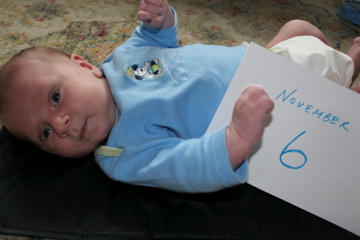
Samuel - 1 month today

I am not very good at sewing. When I was a child my mother sewed almost all of my clothes and most of hers. She started to quilt after she was diagnosed with cancer. I think it was cathartic for her. Anyway, when she passed away I received one of her sewing machines. Someone borrowed it before I received it and did some damage. So, even if I could sew, I wouldn't be able to.... One of my goals is to start to sew!

My children have been in cloth diapers (AIO - All In One). However, Gavin (age 2) is keen on the idea of underwear. I thought I would venture out and find some thicker training pants. The type that are like underwear, yet thick like a diaper. I searched and searched and searched. No one carries these any longer. I guess we are supposed to be using disposables.

I know that many people prefer to use disposables because they are easier and the like, but I can't stand thinking about the waste that is created by using disposables. If I don't have options, then what am I supposed to do? Couldn't stores carry just a few for people who want to reuse? We really are a disposable society! Diapers, pull-ups, bottles, bibs, sippy cups are all disposable! Of course, I think about the corporations who know that if we use their disposable items, then we will keep purchasing them from those companies. If we have few choices, then we will have to choose the disposables over the reusables (which are unavailable).

It also makes me thikn about how much is used to create something disposable. The energy for the materials, production, distribution, disposal.... At least with cloth it is being reused (and does not have to be recreated for each use)!

BTW, I found some training pants online. I have ordered those (a justifiable purchase). I also located a place to fix my mother's sewing machine. I will NOT go through this again.

Sunday, October 22, 2006

with hope

I have been dismayed at the state of our world. I feel that we will soon be seeing a new world - much different than what we are accustomed to living in. Climate change and peak oil being some of the causes. Our clean water supply is dwindling, our food sources are 2000 miles away, and our temperature is getting hotter and/or more extreme, and an economic depression is predicted. So many of us are simply oblivious to the events of the world around us. It truly frightens me.

We have a neighbor who was very interested in converting a car to run on vegetable oil (as we have). Well, now that oil prices are "going down" he does not see the point in doing so. Wow. There are so many people who don't "see the point" in making changes. Is it too difficult?

What brings me hope is that there are a growing number of people like me - who have woken up to the dangers around us and are choosing to make changes that we can. I read blogs written by people who are not satisfied with living the status quo and are choosing simpler lives. These people are choosing to eat locally, organically, grow their own, go without, not drive, compost, etc. I hope that an ever increasing number of people realize that we cannot continue living like we have been.

My spouse and I have been making changes and saving money in order to change our lives.

Just a few of our goals:

  • pay off house (no debt and always have a place to live). All of the income J brings home goes toward this.
  • in 2-3 years, buy a house or land up north (with enough land to grow our own).
  • learn skills that will be useful in any situation (food growing, preservation, seed saving, water collecting, soap making, spinning, chickens, cheese making)
  • significantly reduce our footprint in as many other ways as possible (solar, wind, rain barrels, etc)
Sometimes I feel odd that we are making changes specifically due to global changes, however, when I think about it further, I realize that the changes we are making are sustainable changes. These are changes which are better for our environment and are better for our family.

Are you concerned about our global future? Are you making changes in your own life in response to possible changes?

Tuesday, September 26, 2006

State of the globe

I am very upset. I read a few websites this morning and was disheartened about the state of our world. Not the nation - the entire world.

First I read:
Global warming nears ‘dangerous’ level
Researchers say average temperatures are close to a million-year high
http://www.msnbc.msn.com/id/15003895/

..."If global temperatures go up another 1.8 degrees F (1 degree C), it would be equal to the maximum temperature of the past million years.

"This evidence implies that we are getting close to dangerous levels of human-made (anthropogenic) pollution," said study leader James Hansen of NASA's Goddard Institute for Space Studies."

Then I read:
Global warming
The inconvenient truth about what we eat
http://www.veg.ca/issues/e-climate-change.html

"
We can also play a key role for positive change by adjusting what we eat – at least 8% of global climate change is directly related to agriculture.

By eating low on the food chain, locally-grown and organic, you can make a significant difference."

We are at a dangerous point of the state of our earth. However, most of us are unaware. Our leaders are not making many efforts to encourage or enforce changes. We don't know what steps we can take to reduce our emissions. And if we do know, they seem so overwhelming or unattainable that we don't even want to try. What type of world are we going to be living in in 20 years? In 50 years? What type of world are we leaving to our children or grandchildren? I don't care if my children will be able to purchase things. I want them to be able to eat fresh foods and drink fresh clean water.

A year ago, I doubt that I would have made any changes becuase I didn't think it mattered. I thought "It is too difficult, I would have to make a change.... Would anything that I do really make a difference? How could I make any difference?"

Well, as an individual, I may not make a huge difference. However, I have to believe that by teaching my children, by sharing my knowledge and attempts with friends and family, by conversing with my neighbors that I have to be making a difference. We have neighbors who are now walking to work, eating locally, recycling and reusing, and changing their consumer habits. Alone I may not be much, but as a growing group, there has to be a difference. Think of throwing a pebble into a pond and the ripples of the waves.

Food
try these things and then add another step!
  1. Buy foods closest to their freshest state (i.e. less packaging). The more packaging, the more energy used.
  2. Cook from scratch (again - less packaging)
  3. buy local (Foods that are transported 3000 miles use a lot of energy)
  4. and/or organic foods. (Pesticides and herbicides use a lot of energy. )
  5. grow foods (anything - even in a pot on a porch. Any step can help).
  6. Eat lower on the food chain (a vegetarian diet can be a very powerful change to reduce climate change. A meat-based diet uses much more energy. Also, the more land that is used to grow plants, the more Co2 can be absorbed by plants - and not released into the air).
I know that there are people who cannot do these things for one reason or another (poverty, education, time, etc). However, any step that can reduce energy consumption can have an impact. Food is just one step along the path toward sustainability and a healthier earth.

Sunday, August 27, 2006

Population

Less than a year ago I had little thought about population growth. Actually, I had little thought of anything outside of my own little existence and what I could purchase.

In April, after I joined the compact, I learned a lot about my role in this world. It was at that time that I really started to think about my role and the number of children I had chosen to have. At times I have tremendous guilt over my choice to have 5 children. I remind myself that this was something I chose to do before I even thought about the choice and the impact on the world. Now that I have a greater understanding, I realize that although I cannot change hte number of children I currently have (or soon will have), I can have a role in determining how we live.

I think choosing what to purchase and what to consume has as large of an impact on the environment as having the number of children that we have. For instance, we are primarily vegetarian - choosing to eat this way uses fewer of the earth's resources than if we were a smaller family and were meat eaters.

" On average, 18,500 litres of water are used to produce 1Kg of meat, the equivalent amount of water used by a typical Canadian family during a one-month period. To feed the typical meat-eater for 1 day requires more than 14,800 litres of water."

"
less that half the farmland in North America is used to grow food for humans; the largest part is used to raise cattle. For each 16Kg. of grain consumed by an animal, meat-eaters receive only 1Kg. of meat. What's more, to satisfy the annual consumption habits of a meat-eater, 3.25 acres of farmland will be needed;"

Also, choosing to use fewer new items (clothing for instance) lessens our impact than if we purchased all new. Yes, we drink a lot of water, however, we drink almost no soda (special occasions) or juices. Again, this is cutting down the impact of our larger family.

Choosing to have a large family means making very prudent choices on how we live and what we use. I think I am more careful now than I would have been if we were a family of 3.

Thursday, August 24, 2006

Central WA Crisis: Underground Aquifer Going Dry

Frightening! More reasons to conserve water. The Aquifer in the midwest is also running dry.
---------

Posted: Tuesday, August 22, 2006

ODESSA, WA - Drive through parts of Central Washington State and you'll
see plenty of farm fields. What you won't see are irrigation canals.
That's because the water comes from deep underground. But there's a
problem. The aquifer is running out of water ... and wells are drying
up. (The same thing is happening in parts of Idaho). Correspondent
Austin Jenkins reports on this Northwest water crisis and a
controversial plan to fix the problem.

It's a twice-a-day chore for farmer Clark Kagele. He climbs on the back
of a dirt bike - or on this day in his pick-up - and makes a 12-mile
loop through his farm near Odessa, Washington. Along the way he checks a
system of pumps that draw water from deep below the earth's surface to
water his crops.

Kagele: Well we've got about 1400 acres here that are being irrigated
under three deep wells and they're all pumping out of the Odessa
Aquifer.

The Odessa Aquifer is an underground water source. Think of it not as a
lake, but ponds trapped within layers of basalt rock. Over the decades,
some of the shallower ponds have been sucked nearly dry. Now farmers are
drilling wells that are more than two-thousand feet deep - where the
water is much different. Kagele stops at a pumping station to show me.

Kagele: This water - I'll turn the spigot on for you - it's probably
running at about a hundred four degrees. If you can get a little handful
there and put it up to your nose - what do you smell?

Reporter: Sulfur.

Kagele: Lots of sulfur. It smells like rotten eggs so we know that's
ancient water.

This water may be old and hot and smelly but it still grows crops. The
Odessa Aquifer is the lifeblood for a vast swath - some 160-thousand
acres - of Washington's farm economy. The problem is the aquifer is
being depleted and farmer's wells are drying up.

Kagele: This little guy right here is the one that went dry overnight.
Was pumping great one day and came out next day and was spinning

In recent years Kagele has had to drill two new wells - hundreds of feet
deeper than the ones they replaced - at a cost of nearly a million
dollars. Kagele's third well is dropping a foot of water a year. There's
broad agreement this is a crisis and the economic stakes are high.

Smith: Not only are we going to lose agricultural operations and family
farms but we're going to lose food processors and a large number of
family wage jobs.

Craig Smith is a Vice President at the Northwest Food Processors
Association. His members process potatoes and vegetables from the Odessa
Aquifer area.

Smith: The bottom line here is that this area is a huge production area
not only for potatoes but sweet corn and many other crops that are
essential to the economy of the State of Washington.

A study paid for by the Washington State Potato Commission estimates up
to 36-hundred jobs could be lost if the Odessa runs dry.

So what's the solution? The federal government is dusting off a plan
from the 1940s. It calls for continuing construction of the Columbia
Basin Project. The CBP - as it's known - brought Columbia River water to
sagebrush country through a series of canals. Now the idea is to extend
the system to the Odessa Aquifer area - something that was always part
of the plan. This would allow farmers to switch from well water to river
water. Ellen Berggren with the federal Bureau of Reclamation is heading
a five-year feasibility study.

Berggren: The Columbia Basin Project was authorized by Congress to
irrigate one-million-twenty-nine-thousand acres and it's currently
irrigating about six-hundred-and-seventy-one-thousand acres.

The question is whether it makes economic and environmental sense to
bring river water to another one-hundred-thousand plus acres of
farmland.

Berggren: One of the very important considerations in our study is
looking at ways of getting water - which would ultimately have to come
from the Columbia River - in a manner that will not affect Columbia
River flow targets for fish.

That's a key concern for Rob Masonis with the environmental group
American Rivers. After all the Columbia Basin Project was crafted more
than sixty years ago. Long before water had to be set aside for
endangered salmon.

Masonis: It may be that you could move water around within the Columbia
Basin project to serve those farms in question without further depleting
the Columbia River. Where it will get more difficult from the
perspective of the environmental community is where we're talking about
further degrading resources that are already seriously degraded.

Masonis says it's too early to know if this has the potential of turning
into a protracted legal battle.

[Wind noise]

In the meantime, scientists continue to monitor the aquifer. Guy Gregory
is a geologist with the state Department of Ecology. We're at a test
well near the town of Odessa. He unreels an electronic tape down the
well. It measures water depth. The tape is 500 feet long. It keeps going
and going and going.

Gregory: We're thinking about getting a thousand foot tape but we don't
have anyone who wants to try and reel it up. It gets kind of heavy
(laughs).

Finally, at 480 feet the tape hits water and an alarm sounds. Since 1971
the water in this well has dropped two hundred feet. Past efforts to
bring Columbia River water to this part of Washington have stalled. But
now with so many wells failing farmers say something has to be done.

Copyright 2006 KPLU

Wednesday, August 16, 2006

Current Events

Today Jonathan and I had a long discussion about the state of current events.

There are a few things that we have recently read about:

Peak Oil - World Wide Depression

"I had the chance to attend a forum last week which had Alan Greenspan as a guest speaker. In his speech Greenspan said, and I am paraphrasing, "when (not if) the global demand for oil exceeds the supply we will fall into a world wide depression". That shook me as well as most of the others in the room. We have all thought about shortages, sky high prices, etc. But I had never thought in terms of a true depression. Has anyone else and, if so, are you preparing in any way for such an event? FYI, Mr. Greenspan did not offer a prediction as to when this event might occur."

Read this while you are at it: http://www.lifeaftertheoilcrash.net/

Here is an interesting article on a blog: http://sustainable-life.co.uk/peakoil

Clean Water Shortage

The BBC had a news item regarding Water shortage as 'a global problem'
http://news.bbc.co.uk/2/hi/science/nature/4796909.stm

Rich countries face increasing water shortages, a report by conservation organisation WWF warns.

A combination of climate change and poor resource management is leading to water shortages in even the most developed countries, it says. It urges water conservation on a global scale and asks rich states to set an example by repairing ageing water infrastructure and tackling pollution.

The report was released in Geneva just ahead of World Water Week. The WWF says economic wealth does not automatically mean plenty of water. Its report reveals that some of the world's wealthiest cities - such as Houston or Sydney - are using more water than can be replenished....


Ethanol Production = Food Shortages

http://www.energybulletin.net/18496.html
http://healthandenergy.com/ethanol.htm

Jonathan read something about ethanol production, however, I do not know where the article is. I think on of those linked above may be the one he was talking about. He said that what he read is that ethanol is one of the most expensive and unsustainable fuels to produce. If we grew enough grains to make fuel, then we would use all of our grains and not have it available for food. Also ethanol uses more energy to produce than it saves.

After Jonathan and I spoke about this, his reaction as that we should move to a farm and be as independent from the current culture as possible. My reaction is that yes, this is all very bad, however, I think that we can do something. I am not an alarmist or survivalist. I think that we should teach what we know. My thought is that he and I have skills. We have proven that we can create a sustainable environment in an urban environment. Okay, we are not 100% sustainable, however, we have made some major changes in our lives to reduce our footprint.

A lot of people recognize that global warming is happening, that peak oil is happening, that people don't want to be dependent on the system. We think that a lot of people want to make a change, but don't know where or how to start. I think that it is possible to take small steps and build on to those. I think that if we can show people how to make small changes and make a start. Enough small changes can create a ripple effect. Look at me; in January I was clueless. Now I have made a lot of changes: wash is hung to dry, rainbarrels, compost, canning food, growing food, walking to the store, non toxic + biodegradeable household cleansers, careful/non consumerism, veggie car, all organic + local foods.... In January, I had not even a thought about this - not a thought about my role or ecofootprint. Small changes spiraled into larger changes.

I think that if we each start small, then we can add to it. Not consuming (as much) or choosing only organic, hanging our wash to dry x-times a week.... Start small and then build onto that. I do think that it is possible as individuals to have an impact and then we can impact our friends and neighbors.

A challenge: this week make a vow to make 1 change. Make it a change that you can sustain.

ideas:

1. Hang clothes to dry
2. Choose to walk/carpool/mass transit/bike this week
3. learn to compost
4. put up a rain barrel
5. don't purchase anything unnecessary
6. visit the local farmers market and buy local food
7. choose organic
8. refill bottles with bulk foods
9. cook at home
10. unplug unused appliances
11. replace lightbulbs with compact
12. other ideas?

One change for a week. Let me know what you decide to do!

Friday, July 14, 2006

Teaching the kids

Every morning I watch the Today show as I start the day. It is one of the few times that the TV is on during the day. This morning there was a segment featuring the Tom Brokaw special which will be on the Discovery Channel. It was about Global Warming. We watched the research that was done about the polar bear population. The polar bear population is dying quickly due to global warming. It was very difficult for us to watch. I found a website shich shows some of hte video clips for the program at:
http://dsc.discovery.com/convergence/
globalwarming/videogallery/videogallery.html


Following hte small segment the kids and I turned off the TV and discussed what we saw. We discussed our roles as humans on the planet. I explained to them that "wastefulness" is a major contributer to global warming. I did not talk excessively about consumption (I thought that might be too much). I asked if they understood what I meant by waste. They understood that it is not good to use too much gas, that using the air conditioner could be wasteful, paper towels are wasteful, etc. Elyse (age 7) said that that is why we choose to walk to the store and not drive. That that is why we wear "hand-me-downs" instead of buying new clothes, that is why we don't buy toys and electronic "toys". I explained that when we are not watching tv, we should, unplug the tv, etc. We talked about how far our food has to travel (in trucks) and that is why we go to the farmers market and grow some of our own foods. We talked about how much grain and water is used to grow cattle and that is why we eat little or no meat (so that others can eat).

The kids seemed to "get it". Zach (age 6) ran around the house and unplugged everything that was not in use. When we went to the bank (had to drive), the kids reminded me to turn off the car so that we would not waste gas. It was absolutely wonderful. I have some "green" books that I will share with Madison (age 12) so that she can have a deeper understanding of our family choices.

On another note, J found someone in Duluth who can help him get our veggie mobile going. Woo woo! I can't wait to see how it works.