Showing posts with label food not lawns. Show all posts

Tuesday, February 27, 2007

Conference on global warming


Last night I attended a conference on global warming. Actually, I had also been invited to have an informational table at the conference. So, I set up a table with my posters, some handouts (a version of the brochures), some flyers, and a sign-up sheet for local people to be notified about classes and get involved in our local community. People signed up!

Wow. It was excited to hear the reaction from people. Most people agreed that this was something that could be done. Reducing our food miles and thus cutting our food emissions is something that most of us can do - by planting our own food, or choosing to shop at the farmer's market or join a CSA (Community Supported Agriculture). I told people how I have eating within a 100-mile radius, preserved food throughout the summer and am sill eating locally. So many didn't know that it was possible to do this in Minnesota (in the winter). People were enthusiastic about this.

Some of the visitors to my table took materials to share with local groups. I was also invited to present at another conference in April, to get the Victory Gardens involved with the Land Stewardship Project, and to speak with some other groups. Look - one idea can have an impact. One action can make changes. We can all do something to make a healthy change for our environment.

One of the speakers at the conference was a local member of congress. He told us that we are making a difference. When we write to our legislators it does make a difference - they become aware that citizens are demanding change. He told us that global warming is a hot topic in Washington and that as we become active in cutting our emissions and demanding changes be made, that our voices are heard. We need to keep demanding legislation!

It is becoming clear that we can make a difference. We need to use our voices and write letters to the editor, write to legislators, make changes in our own lives. Some of the changes may be uncomfortable, but if we can think about our children and grandchildren and the benefits for them, then the changes can be less painful. I would personally prefer difficult changes now than a world that is difficult to live in in the future.

The problem with the topic of global warming is it is a topic that is "over there." We hear about it and think that it is something that the government has to do something about, or that is something bigger than us. It is big, however we are the individuals who can make a change that will make a difference. Every little change that we make adds up. The climate changes will affect us. Check to see how your local environment could be affected. Let's make a difference.

Sunday, January 28, 2007

Victory Garden update


After the tremendous response to the idea for a victory garden to fight global warming, I created a poster, flyer, and tri-fold brochure. I am currently working on a website as well.
http://www.urbansustainableliving.net/VictoryGarden/

The poster is an 11x17 full color poster. The flyer is 8.5x11 black and white (can be photocopied). The brochure is a full-color trifold. These are all available on the website mentioned above.

This was fun to create. Yes, I enjoy using my graphic design powers for good. (I tease my students about having superpowers in design - and the need to choose to use the powers of persuasion for good rather than evil). Please feel free to use these.

Planting a Victory Garden can be such a simple step towards sustainability and easing our dependence upon pollution creating systems.

***** Edit
After contemplation, I changed the tag line to read "for victory over global warming." I had not realized how pervasive the term "fight the war on..." had become. It had become ingrained into my subconscious. I think it shows how hearing a phrase repeatedly seems to become part of the "norm" of our vocabulary.

I think "Victory over.." sounds more hopeful, yet is active enough to engage people who would otherwise not be interested.... And it still could be construed as a fight over something :)

Tuesday, January 23, 2007

Revive the Victory Garden


I am obsessed with food. Of all of things that we can purchase, food is the one thing that nourishes us. Yes, items can nourish our soul, but food is what nourishes our bodies - -so that we can live. I think this is why so many of my posts are about food. We cannot go without.

60 years ago we were at war. We were fighting an enemy at faraway lands. Our government encouraged us to plant gardens at home. People came together to fight this enemy by planting gardens in their backyards. These gardens could help us fight the enemy from home and gave our citizens a sense of national purpose. Magazines told people how to plant and tend to a garden. Co-ops were developed. This community effort brought together families and neighbors to provide their own food so that more was available for the war effort.

Today we are again at war. This enemy does not have a face. It is not an enemy that we can see. However, this enemy can threaten the nature of our lives and planet. This enemy is global warming. Let's fight is by planting a garden. A victory garden over global warming.

Why would planting a garden have an impact on global warming? Our current food system is created so that the salad that you are eating today (in January) has traveled over 1500 miles to get to your table. The lettuce and tomatoes have been sprayed with petroleum based pesticides, heavily packaged, and transported in air polluting airplanes and trucks. This salad has contributed to global warming.

Start making plans for the future. Dig up your lawn and plant a garden. If you don't have a lawn, put plants in pots on your patio or balcony. Use your rooftop. Or, if needed, visit your farmer's market. Eat with the seasons. Talk to a neighbor. Let's become a community fighting this enemy. Let's no longer make the 1500 mile salad a standard. Let's fight global warming with a victory garden.

btw, need more incentive? one 2 cent seed will provide many more veggies than you can purchase for that at the store. planting a garden will save money!

Saturday, December 16, 2006

Food Not Lawns #2 - Research

I have been doing a lot of planning and thinking since I originally posted my "Food Not Lawns" idea. I have read numerous books and have done a lot of sketching. Right now I am still at the planning stages. I know that I want to create a beautiful landscape, yet have it functional (edible).

Part of the decision to do this comes from my desire to know where my food comes from. I know that I have not sprayed the food with various chemicals. I want my food to be close and not travel 1500 miles to get to me. I can't get much closer than walking out my front door. I also want to know that my food is not contributing to climate change. How? Well, food that is grown and sprayed with chemicals adds to the problem -- as the creation of the chemicals is bad for the environment. Then the truck, plows, and tractors which plant, harvest, and transport our food emit CO2. If the food is processed, that emits Co2. I believe I read somewhere that our foods use 10 calories of energy to create 1 calorie of energy. It seems out of proportion. I'd rather walk out my door.

So, in the research of this I have read Gaia's Garden (thanks for the recommendations). Wow. It opened my eyes. There is so much that I thought impossible, that now is possible.

In this book I learned about water catchment systems, using grey water, and forest gardens. Forest Gardens? Yes. It turns out that I can use the shady area in the back. The shady area is dominated with a canopy of tall trees. I can plant fruit trees under those trees. I can plant fruit bushes under those and herbs and shade vegetables with the bushes. It is very exciting to me!


I drew a map of our property (not to scale). I also found some pictures from our sidewalk designing phases. I have included notes regarding the light and shade during periosd of the day.

So, thus we start. I am now going to use the sketch and the photos to plan the garden.

Next will be a decision of what the beds will look like, how paths will weave through, and what plants I will start with. I have also been reading about plants which are beneficial to one another.

I have seed catalogs and have been taking notes on the light/shade issues, companion plants, and germination periods. I need to think about when to plant various plants and when to start some of these indoors.

There is still a lot of research and planning to do, but I feel that I am off to a good start.

I look forward to sharing more of this journey soon!


The yellow mercedes in the driveway is our veggie car!

Thursday, December 07, 2006

Beyond corn -- food for thought

Suddenly it seems as if everything I read or see has to do with food. It is more than recipes or how to grow veggies, but it has to do with the nature of what we eat.

I recently saw "The Future of Food." The Future of Food is an in-depth documentary about the engineered and genetically modified foods that have entered our food shelves. It was frightening to realize how big corporations (such as Monsanto) have genetically modified seeds so much that we are now unable to save seeds. We don't know the impact of these foods on the rest of our seeds.

See, once upon a time we would grow our food and collect the seeds to be grown the following year. Without those seeds we would only be able to grow food one time. We would have to purchase seeds every year. Well, now seeds are engineered so that we are unable to save the seeds. They are made to grow only once. This makes us dependent upon the corporations which developed the seeds. We would have to purchase the seeds every year to planted again.

This documentary covers other issues about the food infrastructure. The laws that cover corporations rather than the farmers. Those who have patents on genetically engineered seeds have more rights than those people whose land accidentally gets planted with those seeds (via wind or the like). It is shocking and disturbing.

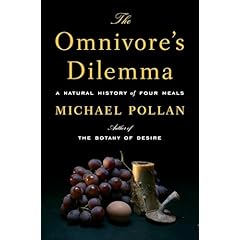
With recommendations by Burdockboy and Tracey, I have started to read the Omnivore's Dilemma.

I am only a few pages into the book. It has already shocked me. I live near corn country. I live in corn country. I always wondered why this area grew so much corn. The pages that I have read answered my question. Corn is in everything. Everything. Corn is in the wax that covers our peppers. Corn is fed to the beef and chicken that we consume. Corn is in soda in the form of corn syrup. Corn is what we consume.

At the same time that I was reading these pages there was an article in the local paper about corn. The demand for corn has sky rocketed. This is because now corn will fuel more than our bodies--it will fuel our cars. Farmers are now deciding whether to sell their corn for ethanol production or food/livestock production. Corn sold for ethanol pays much better than the latter. What does this mean?

Farmers are deciding to sell their corn for ethanol (to fuel our cars). This means that there is less corn available for the food market as mentioned in the Omnivore's Dilemma. There is less corn available to feed livestock/soda/food mixes/boxed foods. Corn prices go up and everything else will have to go up.

I think that it is time for us to take control of our food. I am trying to eat food in closest to the form that it originally came from. I know I am doing well when my husband tells me that we have nothing in the house to eat and then I create a scrumptious meal (ingredients rather than a box). I am now buying heirloom seeds instead of GE seeds. I want to know where my food comes from and have as much control over it as possible. I want to eat food that does not travel 1500+ miles.

This time of year may be difficult to start thinking about eating locally (especially for those of us in the cold north). However, I challenge you to start thinking about it. I think we should wean ourselves from boxes of food and return to ingredients. That will make it easier to eat locally when the farmer's markets reopen in the spring.

Monday, November 27, 2006

Food not Lawns #1


So, I have decided to start Edible Landscaping aka "Food not lawns" (thanks Burdockboy). Okay, it may not be a movement, however I have decided to do this for my family. Perhaps my community may become interested. I also told some of my students about this idea. These students are working on a public service announcement campaign about living responsibly (climate change/peak oil/water issues/consumerism). I do know that a few of them are interested in the idea -- they asked me about it after class. :)

A clerk at a local grocery store is a horticulture student at the local college. I have asked her if she had heard of edible landscaping. She had not. I told her about what I want to do. She is going to make a list of great plants to grow along with the fruits and veggies. She does know a lot of medicinal herbs. So, this will help a lot!

Thus far I have looked through a catalog of heirloom seeds. Seed savers is an organization that focuses on saving heirloom seeds. http://www.seedsavers.org/ I am very interested in heirloom veggies (not genetically modified). Seed savers is located near Des Moines, Iowa. This means that their sucessful seeds (in that area) would be fairly similar to mine. I am going to look closely at seeds which fulfill our needs (cold weather, long storage, etc).

I have also been reading Seed To Seed by Suzanne Ashworth. It is an excellent resource for not only the how-tos of saving seeds but also the growing of and additional information.

I think it will be important to grow a mixture of veggies, fruits, herbs, and flowers. I need to determine what will keep away the bunnies. OR - do I plant extras just for the bunnies?

This is the time of year to start the planning of the garden. I have some grid paper and am planning the layout of our garden. I have to keep in mind that this will be a multi-year effort.

The next step will be the plans. I will post those as soon as I come up with something! I will also talk to one of the local organic farmers about doing this. I am one of her "regulars" at the Farmer's Market. Perhaps she will even allow me to "shadow" her or help on her farm.